Buying Property in Algeria: 2026 Legal & Practical Guide

Last updated: October 12, 2026
Buying Property in Algeria: 2026 Legal & Practical Guide
Purchasing a home, apartment, or development plot in Algeria represents one of the most consequential personal and financial investments for families and diaspora investors alike. Given the nuanced legal structure of Algerian property rights—ranging from fully titled individual land registry deeds to undivided co-ownership (Fi Ech-Chouyoua) and administrative certificates of possession—navigating the property market requires methodical precision. Entering 2026, progressive digital initiatives across land conservation offices (Conservation Foncière), reinforced notary audit standards, and smart marketplace platforms are reshaping how real estate transactions are verified and executed across all 58 wilayas.
Whether you are looking for an apartment in Algiers, a suburban villa in Oran, or commercial land in Constantine, ensuring clear ownership title, conducting rigorous structural inspections, and understanding mandatory transaction taxes are essential steps to safeguard your capital. This comprehensive 2026 guide details the complete legal roadmap: deciphering cadastral titles, estimating notary and registration fees, conducting onsite physical audits, negotiating market prices in Algerian Dinars, and capturing off-market opportunities using the instant Sniper push alerts on the L'Affaire platform.
🎯 Key Takeaways
- A notarized authentic deed published at the Land Conservation Registry accompanied by an individual Land Registry Book (Daftar Âaqari) is the only instrument granting unassailable property rights under Algerian law; private handwritten contracts (Papier Blanc) are null and void.
- Preliminary cadastral investigation at the local daïra land office prevents costly entanglements involving hidden bank mortgages, administrative demolition orders, or unpartitioned inheritance disputes (Fridha).
- Mandatory notary and government registration fees total between 4% and 7% of the officially declared transaction value, covering Treasury registration duties, land publicity fees, and regulated notarial tariffs.
- Thorough physical and utility inspection (concrete core integrity, Sonelgaz electric and gas compliance, underground water reservoirs, and terrace waterproofing) protects buyers against expensive post-purchase defects.
- Real-time marketplace monitoring tools like the Sniper alert feature on L'Affaire allow smart buyers to receive instant push alerts the moment a genuine deal is listed in their target wilaya.
📋 Table of Contents
- Understanding Property Legal Statuses in Algeria
- Mandatory Due Diligence on Title Deeds and Cadastral Records
- The Notary's Role and Official Transaction Process
- Onsite Technical Inspection and Structural Checklist
- Negotiation Tactics and Payment Procedures in DZD
- Frequently Asked Questions on Algerian Property Purchases
Understanding Property Legal Statuses in Algeria
Under Algerian real estate jurisprudence, absolute legal security requires an authentic deed drafted by a state-commissioned notary and officially published at the Land Conservation Registry along with an individual Land Book. Because properties listed across public classified portals carry varied legal pedigrees, distinguishing valid titles from high-risk arrangements is the fundamental starting point of any acquisition.
Prospective property buyers must categorize opportunities into four primary legal frameworks:
- Titled Property with Authentic Deed and Individual Land Book (Acte Notarié + Livret Foncier): This represents the gold standard of real estate security in Algeria. The parcel has undergone official cadastral surveying, boundaries are definitively registered, and the vendor holds a direct title deed (Daftar Âaqari). This status allows seamless resale, unencumbered transfer, and full eligibility for regulated home loans.
- Property in Undivided Co-Ownership (Fi Ech-Chouyoua): Extremely prevalent in multistory residential homes built by families or small private developers before formal subdivision, buyers acquire an undivided share rather than an autonomous cadastral unit. While notarized, this status can create future complications regarding pre-emption rights by other co-owners or inheritance gridlocks unless a notarized division plan (État descriptif de division) is completed.
- Certificate of Possession (Certificat de Possession - CP): Frequently encountered in rural or suburban zones that have not completed state cadastral formalization, this municipal document recognizes peaceful possession of agricultural or private land but does not constitute full constitutional ownership. Transforming a certificate of possession into a definitive land book requires an administrative surveying process spanning at least two years.
- Private Handwritten Contract or "Stamped Paper" (Papier Blanc / Timbré): Contracts executed solely between private parties and stamped at the local town hall (Baladiya) are strictly null and void under Article 324 bis 1 of the Algerian Civil Code. Engaging in transactions under this informal guise exposes buyers to total loss of property with no legal recourse.
To safeguard your investments against questionable schemes, review our classified ads safety and fraud prevention guide to spot common warning signs during seller communications.
| Legal Status | Official Instrument | Security Grade | Bank Financing | L'Affaire Recommendation |
|---|---|---|---|---|
| Authentic Deed + Land Book | Published Notarial Deed + Livret Foncier | 🟢 Maximum (100%) | Eligible | Highly recommended |
| Undivided Co-ownership | Notarial Deed with percentage share | 🟡 Moderate | Heavily restricted | Requires verified division plan |
| Certificate of Possession | Municipal administrative certificate | 🟠 Low to Moderate | Ineligible | Specialized investors only |
| Handwritten Stamped Paper | Private contract stamped at Baladiya | 🔴 Zero (Illegal) | Impossible | Strictly prohibited |
Mandatory Due Diligence on Title Deeds and Cadastral Records
Performing exhaustive document verification at the competent land conservation office and municipal urban planning department confirms that the vendor holds exclusive alienable rights and that the property is completely unencumbered by liens or code violations. Never disburse deposit funds prior to reviewing these verified documents.
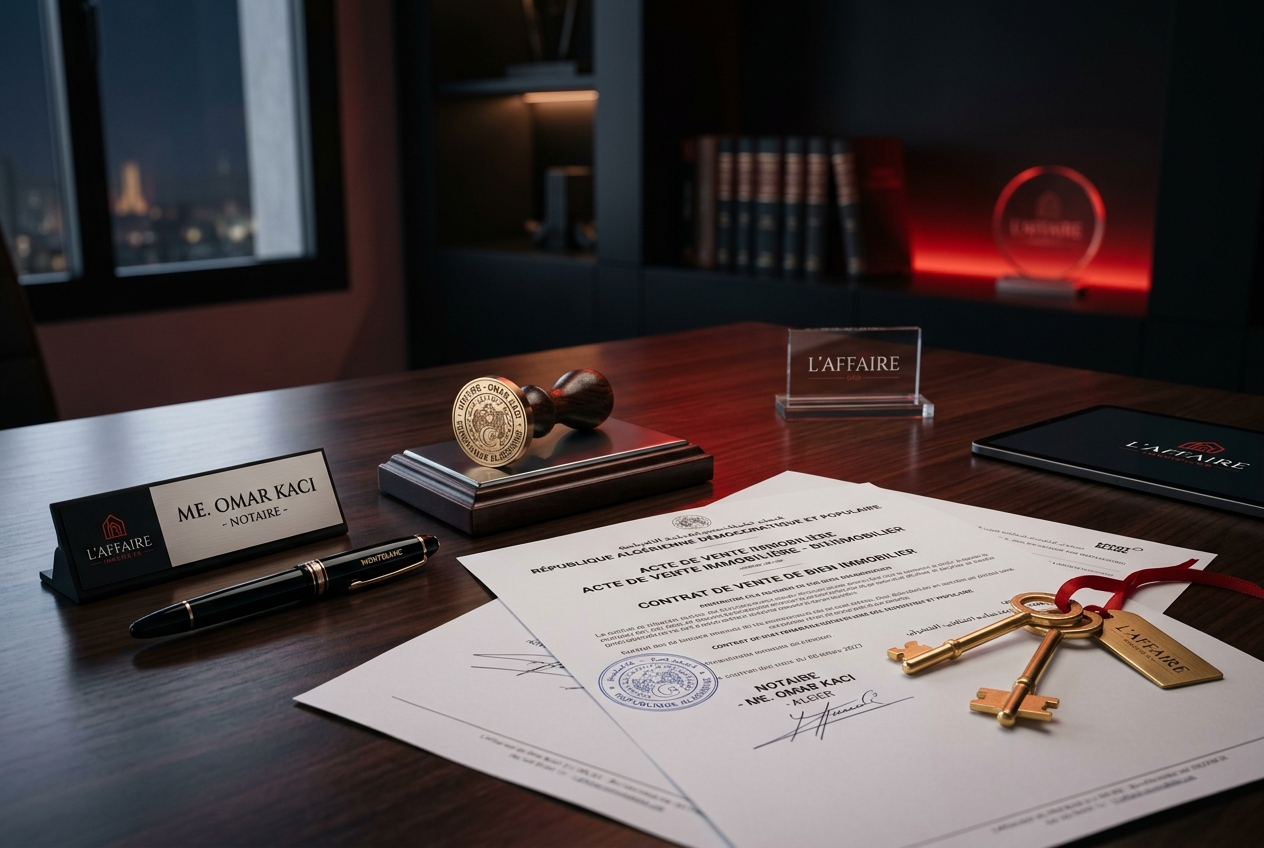
Buyers must insist on inspecting full certified copies of the following documentation:
- Full Notarized Title Deed (Acte de Propriété): Review how the current seller acquired the property (direct purchase, inheritance, or notarized donation) and ensure registration stamps from the Land Publicity Bureau are clearly legible.
- Updated Land Registry Book (Livret Foncier): Cross-check volume, page, section, and cadastral lot numbers against the exact physical footprint of the house, apartment, or land parcel.
- Certificate of Building Conformity (Chahadat El-Moutabaqa): For modern villas and private residential developments, this urban planning certificate issued by the municipality confirms construction adheres to authorized building permits and Law 08-15. Without it, formal notarized deed drafting for upper floor apartments can be halted by the notary.
- Inheritance Certificate (Fridha): If the property is being sold following the death of an owner, all surviving heirs identified in the notarized Fridha must either attend the signing or grant registered special power of attorney (Wikala). If even one heir is missing or contestation exists, the transaction cannot proceed.
- Negative Mortgage and Lien Certificate (Certificat Négatif d'Hypothèque): Sourced directly by the notary from the Land Conservation Bureau, this document certifies the asset is not mortgaged to a commercial bank or seized by judicial authority.
For additional best practices on evaluating listing disclosures, consult our guide to photography and copywriting for classified ads to understand how professional sellers present verifiable credentials.
The Notary's Role and Official Transaction Process
Under Algerian statutory law, a notary is a public officer endowed with state authority, exclusively authorized to authenticate real estate conveyances and handle official public registration. Selecting a reputable notary in the property's wilaya provides ironclad legal certainty.
The standard notarial acquisition process follows four disciplined stages:
- Case Opening and Cadastral Requisition: Upon verbal agreement on terms, the notary files an official requisition with the Land Conservation Registry to confirm title viability while gathering buyer and seller biometric identity cards and 12S birth records.
- Drafting the Preliminary Sales Agreement (Promesse de Vente): If the buyer is assembling personal funds or awaiting bank mortgage approval, a notarized promise of sale outlines completion deadlines (usually 30 to 90 days) and establishes an escrow deposit (typically 10% to 20% of the sale price).
- Escrow Funding via Notary Treasury Account: To comply with Algerian anti-money laundering statutes, transaction funds must be deposited into the notary's designated Public Treasury account or processed via verified bank cashier checks (Chèque de Banque). Direct cash handovers are strictly prohibited for titled conveyances.
- Final Deed Execution and Cadastral Registration: The notary reads the complete deed aloud to both parties, obtains formal signatures and biometric thumbprints, files mandatory registration taxes with the tax inspectorate, and submits the file for cadastral publication to generate the final certified deed (Expédition).
Typical Real Estate Notary & Statutory Fees in Algeria:
┌───────────────────────────────────────┬───────────────────────────┐
│ Fee / Statutory Duty                  │ Approximate Official Rate │
├───────────────────────────────────────┼───────────────────────────┤
│ Registration Duty (Public Treasury)   │ 2.5% of declared price    │
│ Land Publicity Tax (Conservation)     │ 1.0% of declared price    │
│ Regulated Notary Professional Tariff  │ 0.5% to 1.0% (tiered)     │
│ Stamp Duties & Administrative Costs   │ Flat fee (~15,000 DZD)    │
│ Total Average Transaction Cost        │ 4.5% to 5.5%              │
└───────────────────────────────────────┴───────────────────────────┘
Onsite Technical Inspection and Structural Checklist
Thorough physical auditing of an Algerian home should be conducted in broad daylight and, whenever possible, revisited during wet weather to detect hidden structural defects, foundation settlement, or water leakage not visible in online listings.

Always conduct a structured onsite inspection evaluating these critical architectural and mechanical systems:
- Structural Framing and Masonry: Examine reinforced concrete beams, columns, and load-bearing brick walls. Diagonal or stair-stepped crack patterns often reveal foundation subsidence or structural distress.
- Rooftop and Terrace Waterproofing: In top-floor apartments and standalone villas, inspect ceilings and perimeter corners for moisture stains, paint bubbling, or efflorescence (Salpêtre), focusing particularly on rainwater drainage channels.
- Electrical and City Gas Installations: Ensure the home features an updated breaker panel with circuit interrupters and check the official Sonelgaz meter installation. Rewiring an uncertified dwelling can cost hundreds of thousands of dinars.
- Water Storage and Auxiliary Pressure Systems: Given intermittent municipal water scheduling in various wilayas, verify the presence of an operational underground cistern (Bâche à eau), an automatic pressure booster (Surpresseur), and clean backup rooftop tanks.
- Neighborhood Dynamics and Accessibility: Visit the surrounding neighborhood at varied times—particularly during evening peak hours—to evaluate access roads, school proximity, parking availability, and ambient noise levels.
To review verified property listings with real video walkthroughs, you can explore opportunities directly on the L'Affaire web portal.
Negotiation Tactics and Payment Procedures in DZD
Negotiating property values in Algeria demands an objective grasp of localized square-meter transactions, which routinely close 10% to 25% below initial list prices found on general classified websites.
To execute a successful negotiation and finalize your purchase:
- Benchmark Verified Local Prices: Research actual closing values across comparable properties in the immediate neighborhood (e.g., Algiers Hydra, Oran Akid Lotfi, Constantine Zouaghi, or Sétif).
- Factor in Necessary Renovation Expenses: Accurately estimate costs for plumbing repairs, heating boiler installation, aluminum double glazing, or flooring upgrades, and use formal artisan quotes to negotiate price concessions with the vendor.
- Align Financial Liquidity with Deadlines: Secure your banking liquidity well ahead of time, accounting for fund transfer clearance between accounts and administrative paperwork for subsidized mortgages (CNL 1% to 3% loans for eligible new-build units).
- Set Up L'Affaire Sniper Alerts: By configuring hyper-targeted filters by wilaya, neighborhood, and maximum budget within the mobile application, you will receive real-time push notifications the instant a qualified deal is published or reduced in price.
For broader context on property tenancy and rental yield comparisons, review our Algerian housing and rental guide.
Frequently Asked Questions on Algerian Property Purchases
Is it legal to buy a property without an individual Land Book in Algeria?
While it is legally permissible to acquire property held in undivided co-ownership (Fi Ech-Chouyoua) under a valid notarized deed without an individual land book, doing so carries ongoing management friction and limits future resale or mortgage eligibility. Purchasing property through informal, unnotarized handwritten contracts is completely illegal under Algerian statutory law.
What are the average notary and statutory tax fees when buying real estate?
Total transaction costs generally range between 4.5% and 6% of the purchase price declared in the notarial deed. This covers statutory Public Treasury registration fees (2.5%), land publicity taxes (1%), and official notary service remuneration established by state tariff regulations.
How long does it take to obtain the definitive registered deed?
While the formal deed signing occurs immediately upon fund transfer at the notary's office, issuing the certified official deed copy (Expédition) following formal registration and land publicity usually takes between 1 and 4 months depending on local land bureau administrative processing times.
Can Algerian diaspora members purchase real estate remotely?
Yes, non-resident Algerian citizens living abroad can seamlessly purchase property without traveling by establishing a specific notarized power of attorney (Wikala) certified by the Algerian consulate in their country of residence, empowering a trusted relative or legal representative locally.
How does L'Affaire assist buyers in discovering top real estate listings?
L'Affaire provides advanced geolocation filters across all 58 wilayas, authentic video tours of available properties, and its signature Sniper alert engine, delivering instant smartphone notifications the second a property matching your exact parameters hits the marketplace.
Conclusion
Acquiring real estate in Algeria in 2026 offers extraordinary long-term value when approached with legal diligence and market awareness. By insisting upon verified authentic deeds and land registry books, conducting thorough onsite technical inspections, and partnering with an experienced notary, you ensure that your property investment remains secure and unassailable for generations to come.
📱 Download L'Affaire — Algeria's premier AI-powered marketplace app with smart alerts and visual search.


👤 About L'Affaire
L'Affaire is Algeria's first marketplace powered by artificial intelligence. Available on iOS, Android, and Web, it connects buyers and sellers across all 58 wilayas with groundbreaking tools: real-time Sniper alerts, visual photo search, and engaging video listings.